
How to Read a Title Plan
Written by Editorial Team · Last reviewed
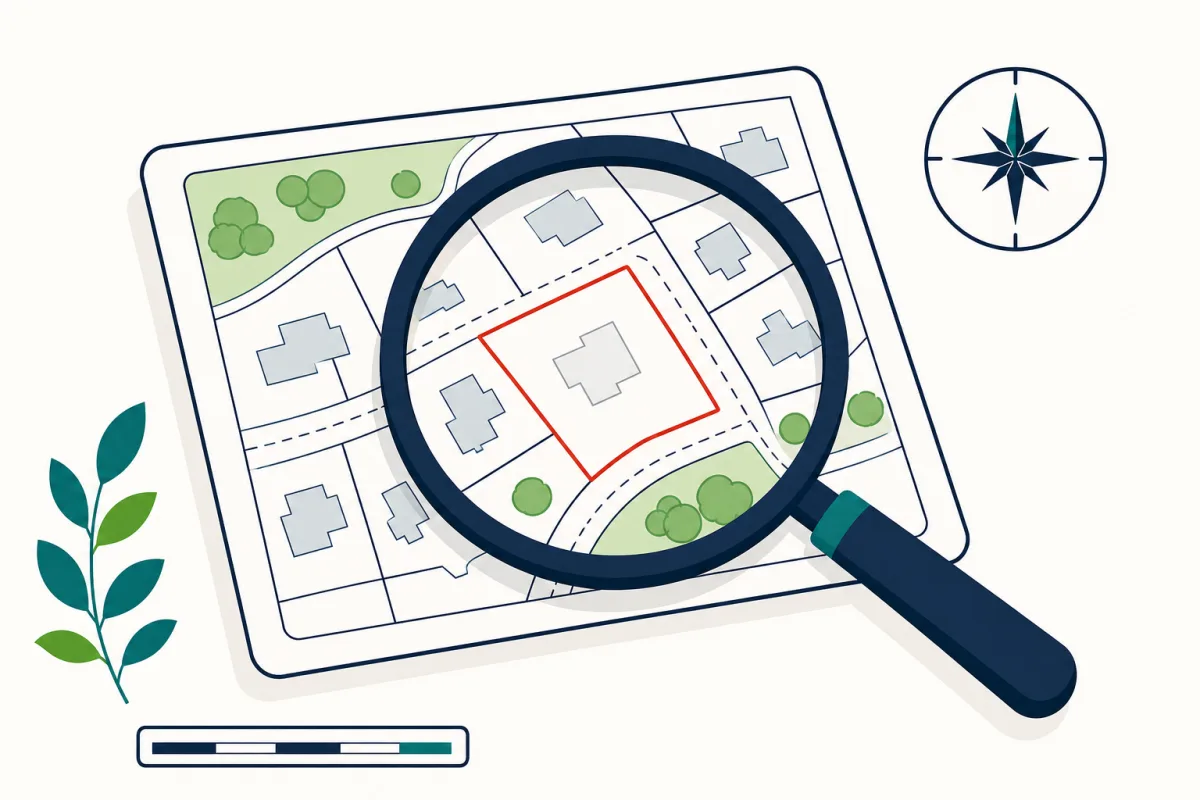
To read a title plan, start with the title number and scale, then find the red edging, which shows the general extent of the land in the title. Any other coloured markings — tinting, hatching or edging in other colours — are explained by entries in the title register, so the plan should always be read alongside the register.
Before you start
Have the title register to hand if you can. A title plan is designed to be read with its register: the plan shows where things are, and the register explains what they are. Reading the plan on its own will answer some questions, but the coloured markings in particular cannot be interpreted without the register.
With both documents in front of you, work through the plan in this order.
A step-by-step walkthrough
-
Check the title number. It appears at the top of the plan, in the same format as on the register — for example AB123456. Make sure it matches the register you are reading alongside it. If a property has more than one title, each title has its own plan.
-
Note the scale and orientation. The scale is stated on the plan — commonly 1:1250 for urban property and 1:2500 for rural land. North is normally at the top. The scale matters because it tells you how coarse the mapping is: at 1:1250, a half-millimetre line on paper is more than half a metre on the ground, which is why measurements should never be scaled from a title plan.
-
Find the red edging. This is the plan's main job: the land edged in red is the general extent of the registered title. Trace it carefully — check whether it includes garages, parking spaces, side passages or garden strips you are interested in. Remember that the line shows a general boundary, so it indicates roughly where the boundary runs, not its precise legal position.
-
Work through any other coloured markings. Plans often carry additional edging, tinting (solid colour wash) or hatching (diagonal lines) in colours such as green, blue or brown. None of these has a fixed meaning. For each one, search the register for the matching phrase — "the land tinted blue", "the part hatched brown" — and read that entry. A tinted strip might be a right of way; green edging often marks land removed from the title; a hatched area might be affected by a covenant. The register, not the plan, is what tells you which.
-
Compare the base map with the ground. The Ordnance Survey base shows buildings, roads and boundary features as they existed when the plan was prepared. If the physical layout has changed since — a new extension, a moved fence — the plan will not reflect it. Differences between the plan and what you see on site are common and are not, by themselves, evidence of a problem.
-
Note what the plan has not told you. Before acting on what you have read, run through the limits below.
What a title plan cannot tell you
| Question | Where to look instead | | --- | --- | | Who owns the land | The title register (proprietorship register) | | Whether the title is freehold or leasehold | The title register | | What covenants or rights affect the land | The title register, and any filed documents it refers to | | The exact legal boundary line | Not shown — general boundaries only, unless a boundary has been formally determined | | Accurate measurements | A professional measured survey | | Who owns or must maintain a fence, wall or hedge | The register and deeds may help; often professional advice is needed |
If your question is about a boundary's exact position, be cautious: almost all title plans show general boundaries, and treating the red line as a precise line is one of the most common mistakes people make with these documents. This article is general information, not legal advice — for a live boundary question, a surveyor or solicitor is the right port of call.
Getting a plan to read
You can order a title plan through our service: we check the address by hand, identify the registered title — contacting you first if more than one could match — and deliver the PDF through a secure link. You can also buy directly from HM Land Registry, which usually costs less; our fee covers the human address checking, retrieval, secure delivery and support. For most purposes it is worth ordering the register at the same time, since the plan constantly refers back to it.
How to Read a Title Plan — FAQs
What do the colours on a title plan mean?
There is no universal colour key. Red edging shows the extent of the title, but other colours — green edging, blue tinting, brown hatching and so on — mean whatever the corresponding entry in the title register says they mean. Always look the colour up in the register.
Why does my title plan look out of date?
The Ordnance Survey base map reflects the features that existed when the plan was prepared. Later extensions, new fences or demolished buildings will not appear. That does not by itself affect what land is in the title.
Can I use a title plan to measure my garden?
No. At common scales such as 1:1250, the width of a printed line can represent half a metre or more on the ground. If you need reliable dimensions, commission a measured survey rather than scaling from the plan.
What if part of my land seems to be outside the red edging?
It may fall within a different title, it may be unregistered, or the plan may simply show the general boundary in a position that surprises you. Check the register, any neighbouring titles and, if it matters, take professional advice before drawing conclusions.
Does the plan show rights of way?
Sometimes a right of way is shown as a coloured or hatched strip, but the plan cannot tell you that on its own. The route only means something once you read the register entry that refers to it.
Sources
- HM Land Registry: get information about property and land (GOV.UK)
- Your property boundaries (GOV.UK)
- HM Land Registry practice guides (GOV.UK)
This guide is general information, not legal advice. Spotted an error? Email support@landregistry-docs.co.uk.