
Does a Title Plan Show Exact Boundaries?
Written by Editorial Team · Reviewed by Property Plan Specialist · Last reviewed
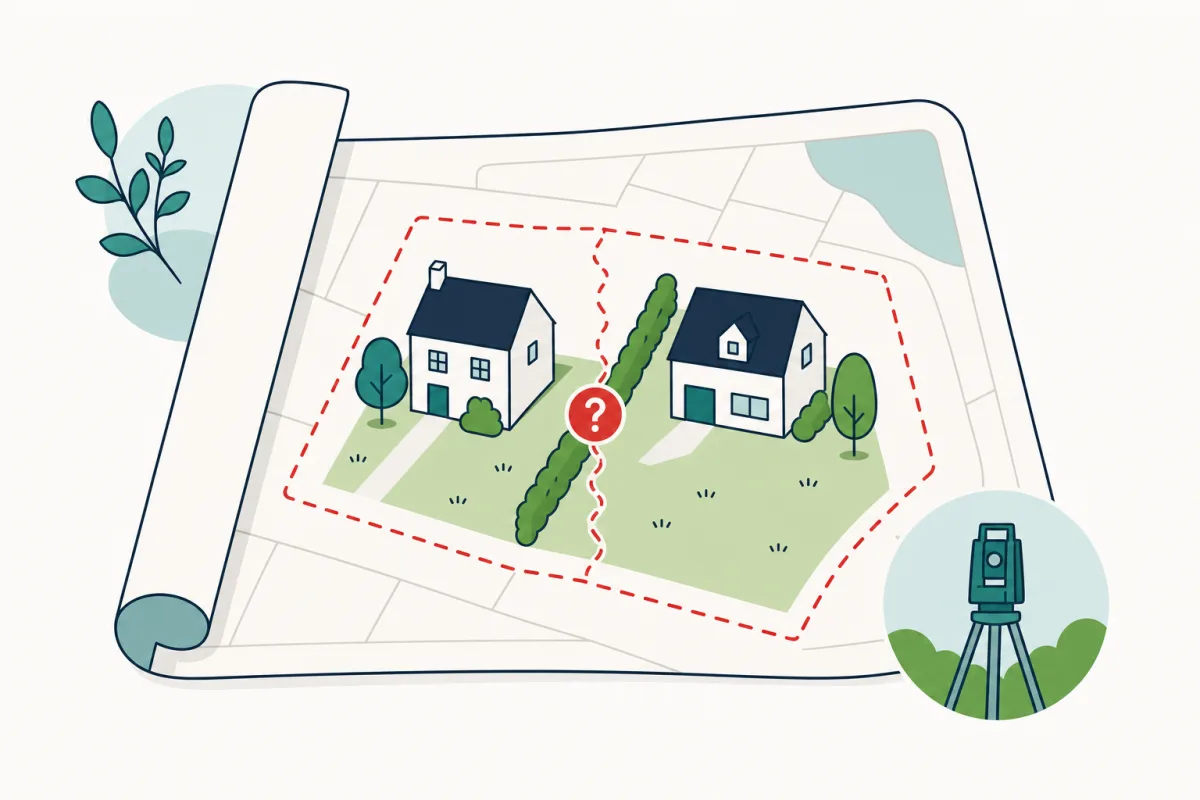
Usually not. Almost all title plans show general boundaries, meaning the red edging indicates roughly where the boundary runs rather than its precise legal line. Exact boundaries only appear where a determined boundary has been formally registered, which is rare. For a boundary question, the plan is a starting point, not the final word.
The short answer
For almost every registered title in England and Wales, the title plan shows general boundaries. The red edging tells you approximately where the boundary runs — usually following a physical feature such as a hedge, fence or wall on the Ordnance Survey base map — but it does not fix the precise legal line. It will not tell you which side of the hedge the boundary sits on, or whether the boundary runs along the centre of a wall.
This is not a defect in your particular plan. It is how the registration system is designed, and it is known as the general boundaries rule.
Why plans work this way
Registering the exact line of every boundary in the country would require a precise survey of every parcel of land, and agreement between every pair of neighbours, at every registration. Instead, the system records the general extent of each title against Ordnance Survey mapping, which is accurate enough for almost all everyday purposes: buying, selling, mortgaging and identifying land.
The mapping scale reinforces the point. At 1:1250 — the usual scale for urban titles — the printed width of the red line itself can represent something like half a metre on the ground. A plan drawn at that scale simply cannot resolve a dispute measured in centimetres.
The rare exception: determined boundaries
The exact line of a boundary can be registered, through a formal application to HM Land Registry for a determined boundary. This requires a precise, professionally prepared plan and evidence supporting the exact line, and the neighbouring owner may object. Successful applications are uncommon, which is why the overwhelming majority of titles have general boundaries only.
If a boundary of a title has been determined, the register will say so. If the register is silent, assume the general boundaries rule applies.
What to do if you have a boundary question
A title plan is the right place to start, but rarely the place to finish. A sensible sequence looks like this:
- Get the title register and title plan for your property — and, where relevant, for the neighbouring property too. Check what each title actually includes and whether the register mentions the boundary, a determined boundary, or any relevant agreement.
- Look at the deeds and filed documents. Older transfers and conveyances referred to in the register sometimes contain more detailed plans or boundary descriptions than the title plan itself. These filed documents can often be ordered separately.
- Consider a measured survey. A chartered surveyor can measure what is actually on the ground and compare it with the plans and deeds. This is the kind of evidence that carries weight, in a way that scaling from a title plan does not.
- Take legal advice before acting. Boundary matters can escalate quickly and the law around them is genuinely technical. This article is general information, not legal advice; a solicitor experienced in boundary work can tell you how the evidence stacks up in your specific case.
Whatever you do, avoid treating the red line on a title plan as if it were a surveyed boundary. It was never intended to be one, and presenting it as one tends to harden positions rather than resolve them.
Getting the documents
You can order the title register and title plan for your property, or a neighbouring one, through our service: we check the address by hand, identify the registered title — contacting you first if more than one could match — and deliver the PDFs through a secure link. You can also buy directly from HM Land Registry, which usually costs less; our fee covers the human address checking, retrieval, secure delivery and support.
For boundary questions the combined register-and-plan order is usually the right starting point, since the plan's markings only make sense alongside the register's entries.
Does a Title Plan Show Exact Boundaries? — FAQs
What is the general boundaries rule?
It is the principle that the boundary shown on a title plan is general unless it has been formally determined. The plan shows the boundary's approximate position, typically following physical features on the Ordnance Survey map, without fixing the exact legal line.
What is a determined boundary?
A determined boundary is one whose exact line has been fixed through a formal application to HM Land Registry, supported by a precise plan and evidence. Determined boundaries are rare; unless the register records one, you should assume the boundaries are general.
My neighbour's fence looks different from the title plan. Who is right?
Possibly neither, and possibly both. Because the plan shows general boundaries at a small scale, modest differences between the plan and the fence line prove very little on their own. Deeds, historical evidence and a measured survey carry far more weight.
Does the title register say who owns a boundary fence?
Occasionally the register or a deed it refers to contains a relevant covenant or declaration, but often ownership and maintenance of boundary features are simply not recorded anywhere in the title.
Can I make the boundary on my title exact?
There is a formal process for applying to register a determined boundary, which requires an accurate plan and supporting evidence, and may involve your neighbour. It is a significant step and most people take professional advice before starting it.
Sources
This guide is general information, not legal advice. Spotted an error? Email support@landregistry-docs.co.uk.